

A traditional CRM helps a firm track relationships and pipeline stages. Acephalt is broader. It behaves more like an XRM: a system that extends beyond contact records into diligence, collaboration, workflows, risk analysis, and decision support.
What a CRM does well
A CRM is useful because venture is still relationship-driven. It helps firms track founders, meetings, pipeline stages, ownership, and next steps.
That operating memory matters. It keeps the team aligned and prevents important context from disappearing into inboxes, scattered notes, or individual memory.
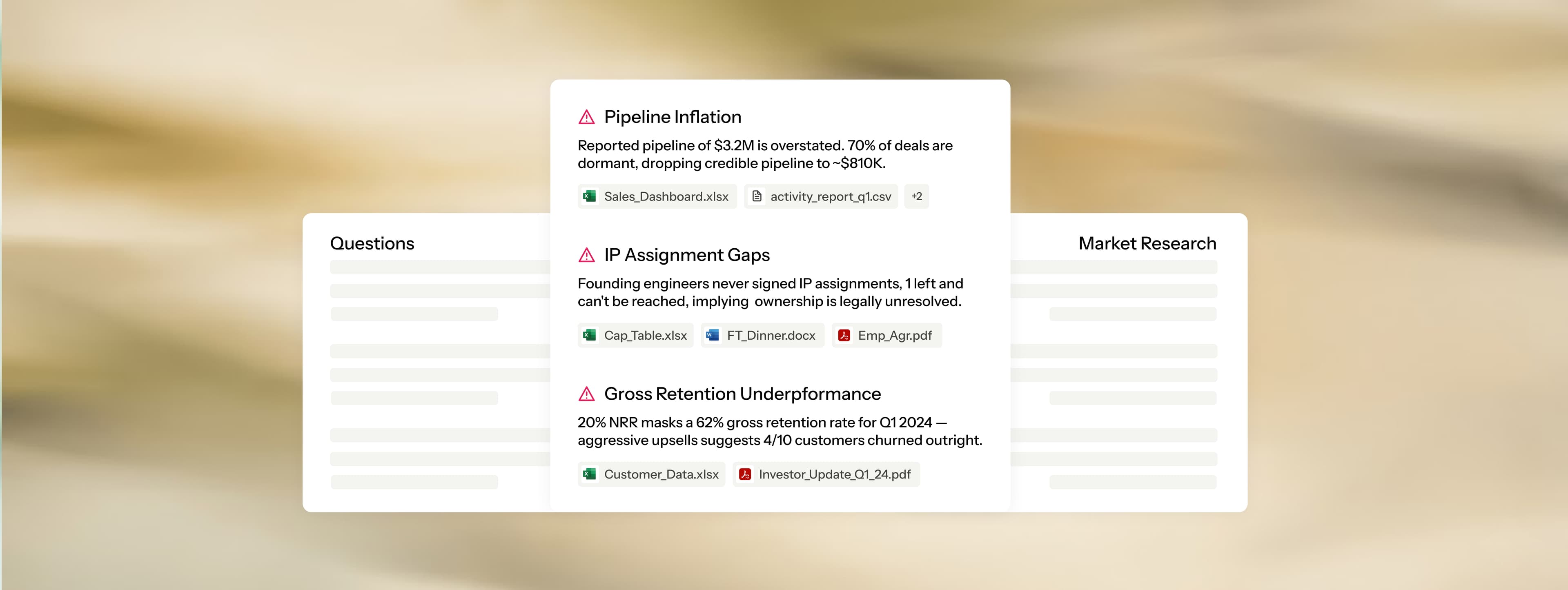
But a CRM mainly answers process questions. It tells you who spoke to the founder, when the last interaction happened, and where the deal sits in the funnel. It does not, by itself, absorb the data room, synthesize fragmented diligence materials, surface structural risks, or help a team get to conviction quickly.
Why Acephalt is better described as an XRM
Acephalt is broader than a classic venture CRM. A better label is XRM: extended relationship management. In practice, that means the system is not limited to a contact database or a pipeline tracker.
From Acephalt’s perspective, that distinction matters because the hard part of venture investing is no longer only sourcing or keeping pipeline records clean. The hard part is understanding a company fast enough to make a rigorous decision. Modern deals generate decks, PDFs, spreadsheets, contracts, transcripts, notes, and research artifacts.
An XRM-style system is better suited to that reality because it manages the relationship context and the operating context around the decision.
“A CRM manages the motion of the deal. Acephalt, as an XRM-style system, helps the firm understand the substance of the deal.”
What changes when you think in XRM terms
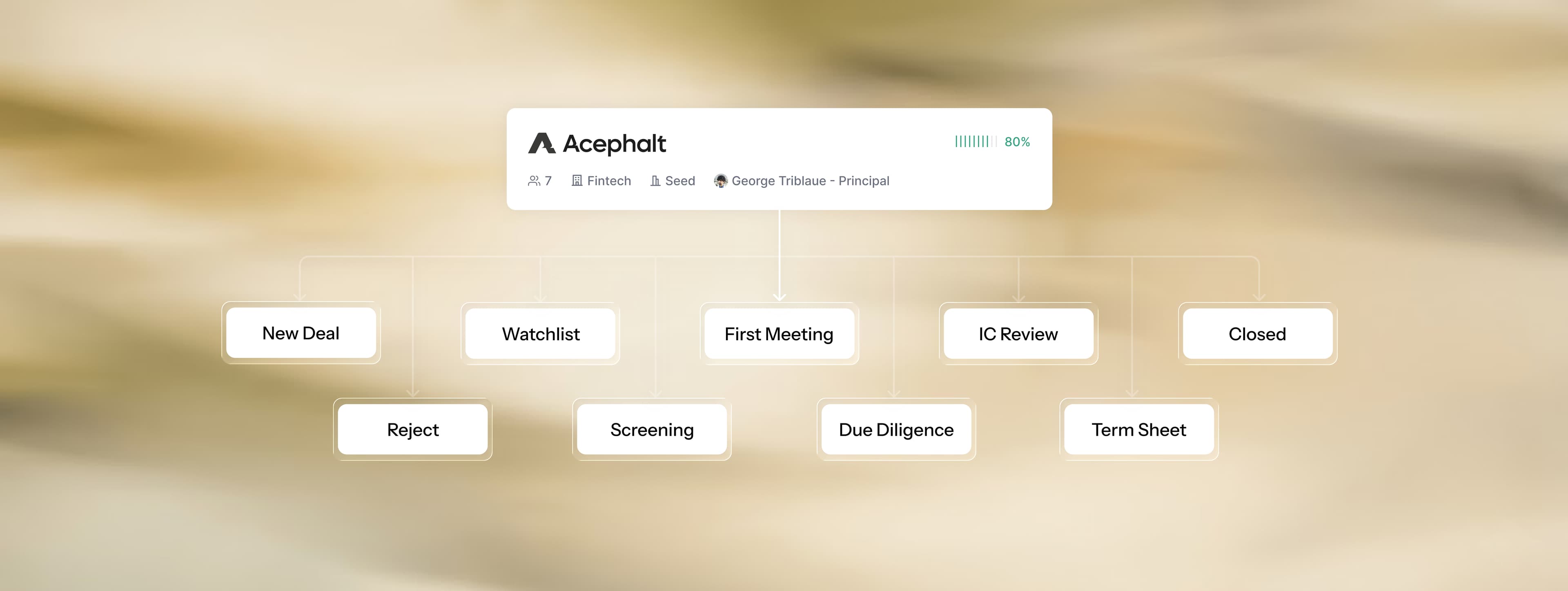
Once you frame Acephalt as an XRM rather than a pure CRM, the category becomes much clearer. The system is not just preserving history. It is coordinating activity across the full investment process.
It links incoming opportunities to diligence workflows, centralizes scattered evidence, supports team collaboration, and helps turn raw information into structured insight.
That is why Acephalt can also be described as a Diligence OS. The platform does not stop at tracking a company in a pipeline. It aims to become the operating layer where investors review materials, identify gaps, compare opportunities, and move toward an investment decision with more speed and consistency.
CRM vs. XRM vs. Acephalt
The distinction is sharpest when you place the three categories side by side. Each answers a different question and operates at a different level of the investment process.
| Category | CRM | XRM | Acephalt view |
|---|---|---|---|
| Primary job | Track contacts and deal stages | Extend relationship management across the full operating process | Connect pipeline, diligence, evidence, and execution in one system |
| Main question answered | Where is this deal? | How does the relationship and workflow move across the organization? | What do we know, what is missing, and should this deal advance? |
| Typical data | Meetings, notes, ownership, next steps | People, docs, workflows, tasks, collaboration, records | Data rooms, diligence findings, Q&A, risks, side-by-side comparisons, investor outputs |
The CRM tracks the deal. The XRM coordinates the process. Acephalt connects both with the intelligence layer.
Why this matters for venture firms now
Venture firms are being asked to process more information with the same or leaner teams. Founders expect faster answers. Competitive rounds reward speed, but good investing still requires rigour.
That combination exposes the limits of a CRM-only stack. Pipeline visibility is necessary, but it is not enough when the team still has to stitch together findings manually across disconnected tools.
An XRM-style platform changes that equation by giving the firm a broader system of work. It preserves context, standardizes review, centralizes outputs, and shortens the distance between seeing a deal and understanding it. That is the lens that makes Acephalt’s positioning compelling: it is not simply a better place to log companies. It is a more complete operating system for how a firm evaluates them.
Final takeaway
If the old venture stack treated diligence as an informal layer on top of CRM, the new stack treats diligence as infrastructure. In that model, Acephalt fits more naturally as an XRM: a platform that extends relationship management into analysis, workflow orchestration, and investment decision support.
“A CRM helps a firm keep track of opportunities. Acephalt aims to help the firm understand them, collaborate around them, and move them forward with conviction.”