
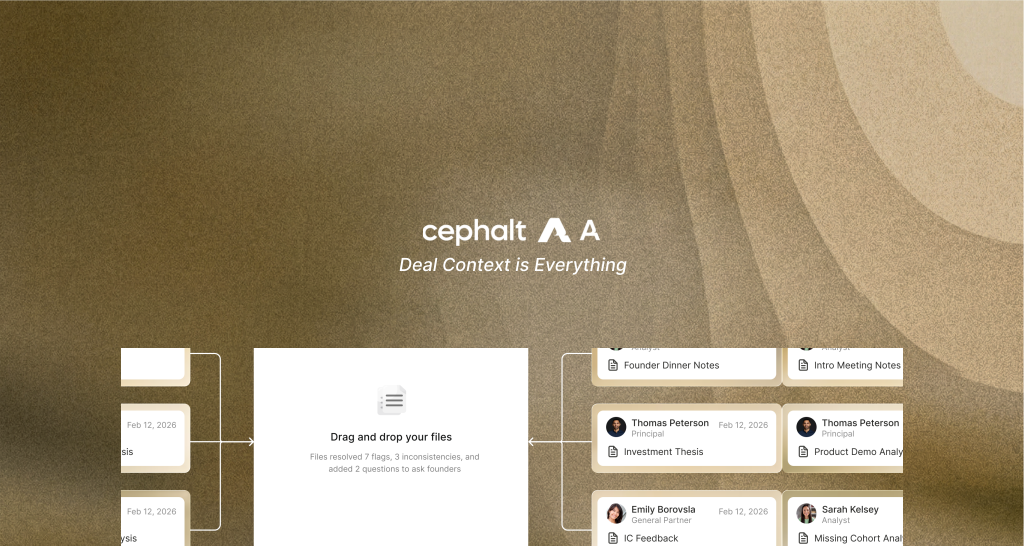
The private equity landscape is undergoing a structural capacity shift. With private asset classes projected to grow rapidly through the end of the decade, deal sourcing, market selection, and transaction scrutiny are intensifying. In an environment where deal velocity and absolute precision dictate fund performance, the primary constraint facing buy-side teams is no longer capital availability — it is analytical bandwidth.
Most technology implementations in the due diligence space operate as temporary data pipelines. An investment team uploads target financials to a virtual data room, queries an analytical engine, extracts a series of data points, and closes the session. When the tab is closed, the underlying analytical context disappears.
At Acephalt, we view this as a massive missed opportunity for compounding data leverage. The future of private market outperformance relies on turning historical underwriting into an active, self-reinforcing knowledge engine.
Moving Beyond Perishable Diligence Data
Every time an investment team evaluates a target company, they generate highly valuable proprietary data. They deconstruct complex adjustments, evaluate specific debt structures, write custom investment committee (IC) memos, and identify nuanced market risks.
In a traditional manual workflow, this operational context becomes siloed across disconnected network drives, local spreadsheet models, and email chains. When a firm passes on a deal or completes a transaction, the underlying institutional knowledge becomes stagnant.
A modernized data infrastructure shifts this paradigm by converting historical transaction data into a live asset from day one. This architecture creates a three-phase data flywheel:
The three-phase data flywheel
Deep Historical Ingestion
Onboard historical IC memos, target financial models, CIMs, and internal evaluations, transforming them into a structured taxonomy native to the fund's investment criteria.
Automated Live Enrichment
As deal teams run new targets through live diligence, every structured model, parsed statement, and risk assessment is captured and cross-referenced automatically — with zero manual data entry.
Exponential Contextual Returns
Each new transaction feeds the central engine, so every subsequent query pulls from an increasingly rich library of firm precedent.
Active Applications of Compounding Deal Intelligence
When historical underwriting data is systematically structured and accessible, it changes how investment committees and deal teams execute transactions on a daily basis.
1. Programmatic Precedent Analysis
When evaluating an active target in a specific sector, an investment professional can instantly extract historical metrics across every similar deal the firm has reviewed over the last decade. Within minutes, the system builds a comprehensive comparison matrix mapping historical entry multiples, margin trajectories, leverage constraints, and eventual outcomes. This eliminates days of manual spreadsheet aggregation before the first introductory call with a sponsor or banker.
2. Retrospective Risk Recognition
Deal teams regularly rotate, and memory fades. An institutional database ensures that the firm remembers precisely why it walked away from a sector exposure or target profile in a previous vintage. If an active deal exhibits specific regulatory or operational risks, the system can surface historical evaluations, highlighting the exact mitigants that were previously considered and rejected. This institutional continuity protects capital across market cycles, regardless of individual team turnover.
3. Granular Covenant and Term Benchmarking
Structuring transaction frameworks allows deal teams to systematically benchmark legal and financial parameters against their own historical precedent. Real-time access to prior debt covenants, basket restrictions, and leverage thresholds gives buy-side teams clear operational data — indicating exactly where market terms are moving and where they can safely negotiate.
4. Continuous Portfolio Optimization
Post-close, structured historical data serves as an objective baseline for portfolio monitoring. Investment teams can dynamically track how actual platform performance diverges from original underwriting assumptions across revenue targets, margin scale, and debt paydown schedules. This immediate variance visualization gives investment committees real-time visibility into broader portfolio patterns, informing future top-of-funnel screening criteria.
Engineering the Infrastructure for Scale
Building a sustainable data edge requires specialized vertical infrastructure. General-purpose artificial intelligence models struggle with the high-stakes computational demands of private equity because they lack the ability to natively parse mathematical logic across multi-tab Excel workbooks or verify unstructured data lineage.
Acephalt addresses this limitation by deploying a dedicated, vertically integrated reasoning framework built explicitly for buy-side underwriting. The system acts as a deterministic calculation engine that executes complex financial math, deconstructs multi-sheet dependencies, and produces fully traceable, source-linked investment workflows. Every calculation, narrative block, and chart generated remains directly connected to its origin cell within the virtual data room, ensuring 100% auditability for internal deal teams and investment committees.
The Long-Term Capital Edge
In the next era of private equity, the funds that sustain superior returns will not just be those with the best sourcing relationships, but those that effectively compound their institutional data over time.
Every single deal your firm reviews represents an institutional asset. Failing to capture that data systematically means starting from a baseline of zero on every new transaction.
Acephalt is built to ensure your institutional knowledge compounds with every underwrite — transforming due diligence from a transaction-specific cost into a permanent competitive advantage.