
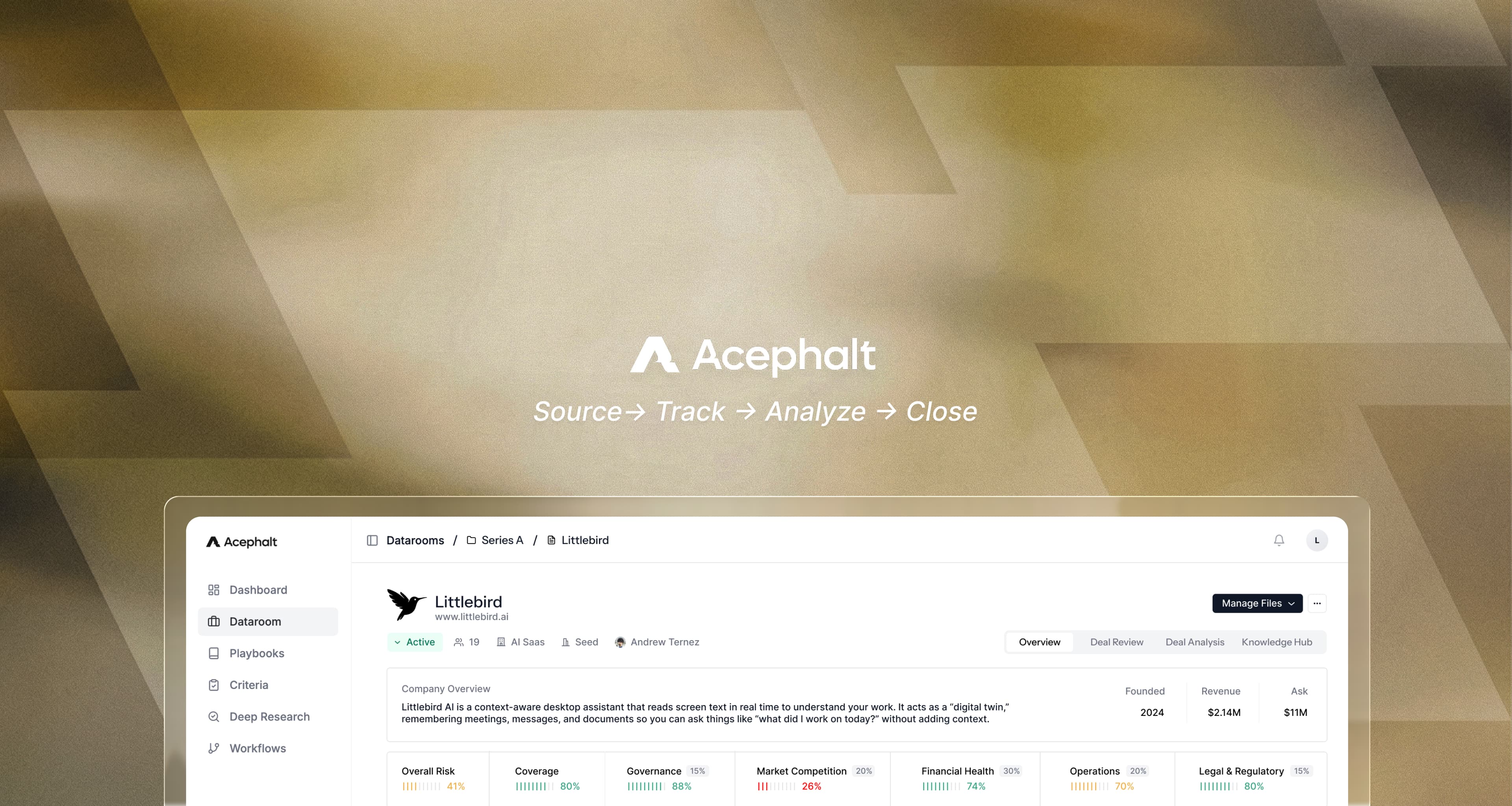
CRMs preserve motion. Acephalt is positioned to create conviction — by turning diligence into a connected, decision-oriented workflow.
The core shift
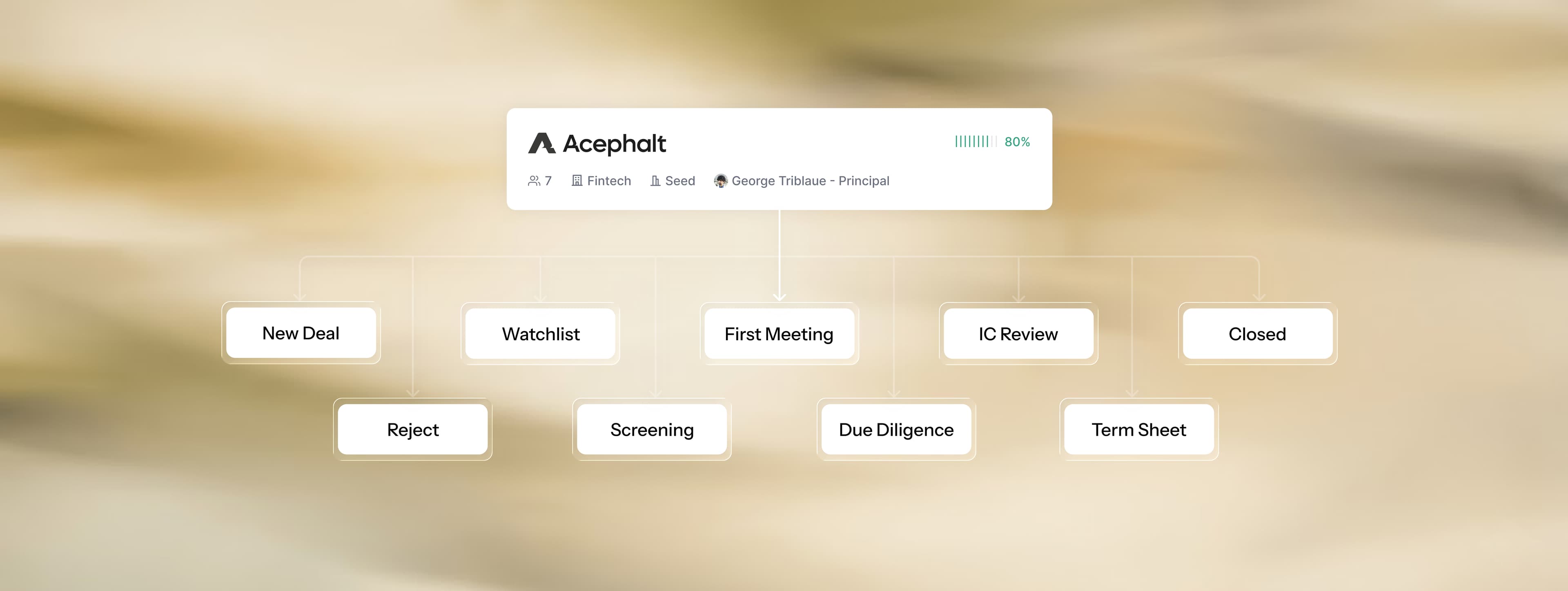
Every venture firm needs a system to track companies, founders, meetings, and pipeline stages. A CRM gives the team accountability and a shared memory for deal activity.
But from Acephalt’s perspective, modern investing is no longer bottlenecked only by relationship management. The real bottleneck often begins after a company enters serious review: teams must make sense of decks, data rooms, spreadsheets, call notes, and ad hoc research under real-time pressure.
That is the gap Acephalt is built to close. Instead of treating diligence as a loose set of manual tasks, Acephalt frames it as an operating layer that helps investors move from raw inputs to structured conviction faster.
Where traditional CRMs stop
A traditional CRM can tell you that a deal is in review, who spoke with the founder, and what stage the company sits in. That is useful. It supports process discipline and helps the team avoid losing context.
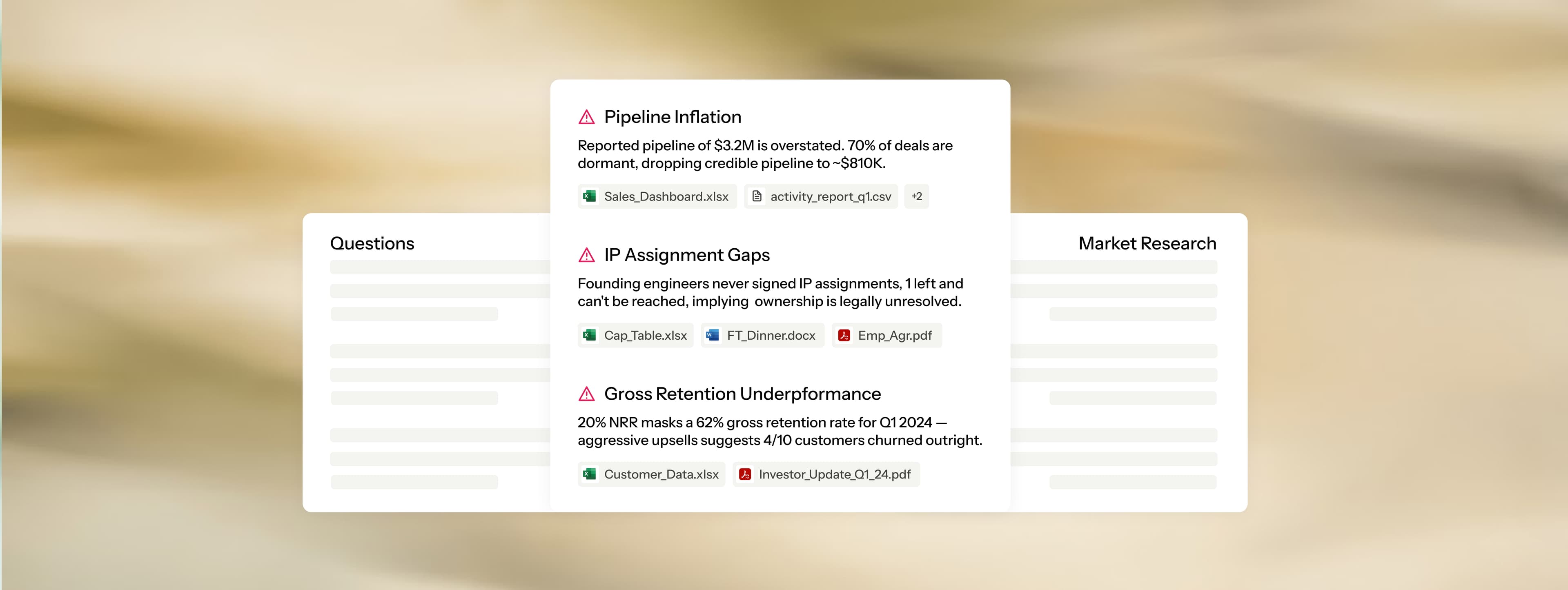
What it usually does not do well is absorb a full data room, surface missing coverage, organise Q&A, highlight risks, compare opportunities side by side, and preserve a decision trail that the full team can use later. In practice, those diligence steps are often spread across disconnected documents and tools.
Acephalt’s position is that the fund stack needs more than a system of record. It needs a system that can turn fragmented materials into decision-ready outputs.
| What a CRM does well | What Acephalt adds |
|---|---|
| Relationships and founder history | Data-room review and synthesis |
| Pipeline stage tracking | Risk and gap detection |
| Meeting logging and ownership | Side-by-side opportunity comparison |
| Memory and operating context | Decision support and diligence deliverables |
The CRM owns the record. Acephalt owns the intelligence layer.
Acephalt’s view of the stack
From this lens, the CRM should own relationship history, pipeline visibility, and operating context. Acephalt should own the intelligence layer: the place where firms upload source materials, analyse them, compare deals, coordinate diligence work, and produce cleaner investment decisions.
That does not make CRM obsolete. It makes CRM incomplete on its own. Acephalt complements the CRM by helping firms understand deals, not just track them.
“The CRM remembers what happened. Acephalt helps the team decide what should happen next.”
Why this matters now
Startups move quickly, founders expect fast answers, and investors are asked to process more information with leaner teams. In that environment, repeated questions, scattered notes, and delayed synthesis are not minor annoyances. They dictate how fast a firm can build conviction.
Acephalt’s argument is that diligence is becoming strategic infrastructure. Firms that can surface risks sooner and move from origination to decision with less friction will compound better judgment over time. This is why Acephalt is best understood as an execution layer for venture investing — one that helps firms review opportunities with more rigour and far less manual overhead.
A sharper way to say it
Buy a CRM to manage relationships. Build your diligence process around a system that can actually evaluate companies.
A CRM tells you what is happening in your pipeline. Acephalt helps you understand whether a deal deserves to move forward. In that sense, the CRM is the system of record. Acephalt is the system of understanding.
Editorial summary
Acephalt complements the CRM by giving firms a connected diligence layer for analysis, comparison, and decision support. The fund still needs a system of record — but the edge increasingly comes from a system of understanding.
“The CRM is the system of record. Acephalt is the system of understanding.”